
Stockholm is a city full of character that offers infinite things to do with kids.
It develops across a cluster of islands, through multiple neighbourhoods, each one with its own mood. Perfect for a family trip as each member will certainly find something amazing to do.
In this guide about the best things to do in Stockholm with kids I will list our top activities in a good mix of indoors and outdoors and of paid and free options.
I hope it gives you plenty of ideas when planning your own family trip to Stockholm.
» Check out my 1-day Itinerary and my 3-days itinerary in Stockholm with kids

A little bit of context of our visit to Stockholm
We visited Stockholm in the second half of October.
The days were getting shorter and temperatures were dropping. We had some rain and cloudy skies, but the city was bursting with Autumn bright reds and oranges.
Our kids were 6, 9 and 11 at the time.
We stayed 3 days in Stockholm in our way to the Swedish Lapland, during a 2-week camper van road trip through Sweden.

Best things to do in Stockholm with kids
1. Explore Gamla Stan
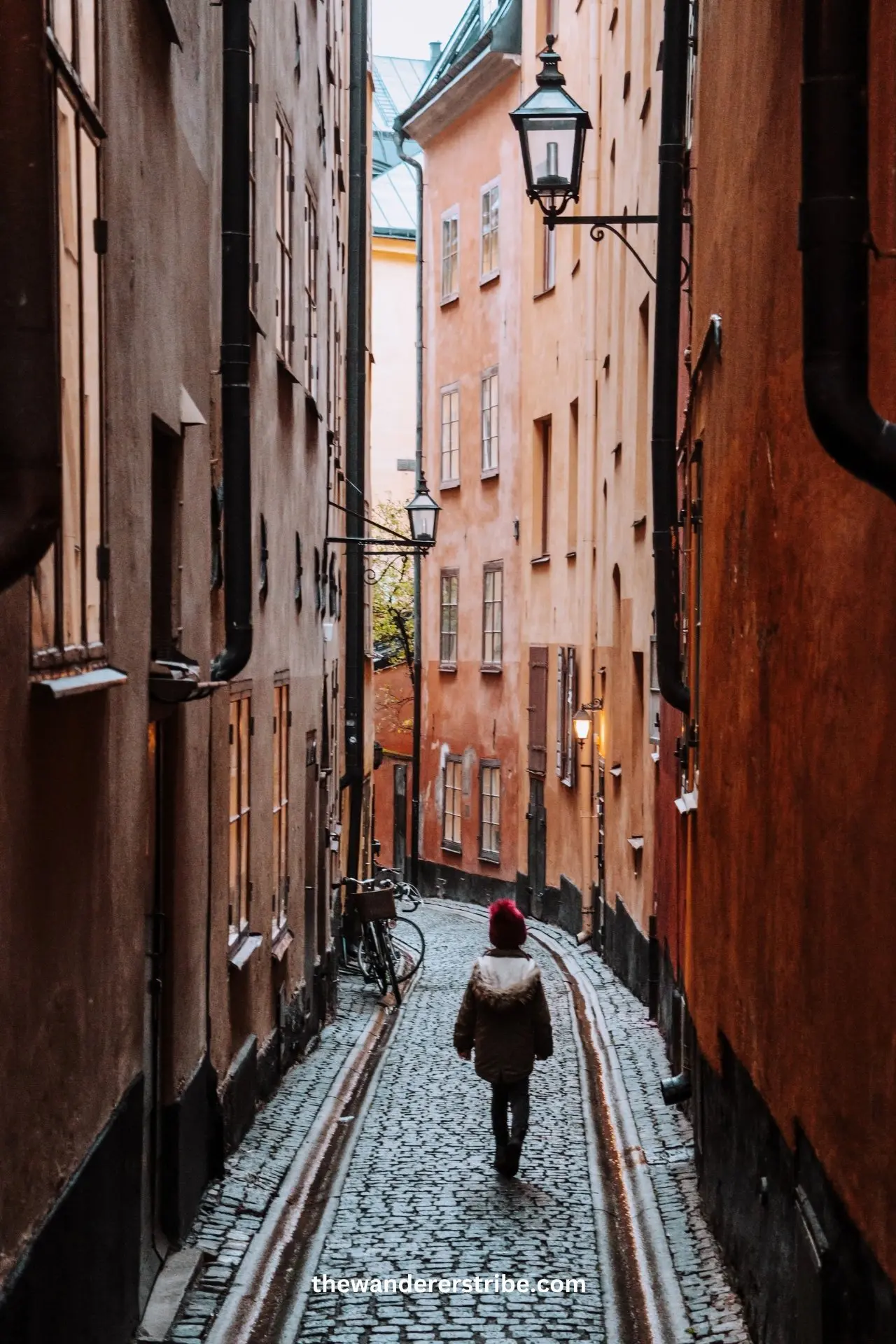
Gamla Stan is the medieval heart of Stockholm. A small island of cobbled streets and narrow lanes delimited by tall, colourful buildings.
This is, without a doubt Stockholm’s post card and the natural place to start.
Despite its small area, Gamla Stan is packed full of things to discover. But don’t worry, everything is within a very short walk and really easy to visit with children.
Other than explore the old streets, which is already an amazing activity in itself, here are some spots not to be missed:
Stortorget
Stortorget is the old town’s main square and certainly the most famous one in Stockholm.
Framed by gabled buildings with warm colours this is the very symbol of the city.
Take your time to enjoy the beautiful setting.
Nobel Prize Museum
The Nobel Prize Museum sits right at the Stortorget Square.
It gets you through the prize history, and the stories of the laureates is a small but super interesting exhibition.
There are guided tours at every quarter past the hour.
Practical information:
Admission fee: 130 SEK for adults, Free for children and young people up to 18 years old when in company of an adult.

Royal Palace
The Royal Palace is the official residence of the Swedish king.
The visit will take you through the grand interiors including the Royal Apartments, the Treasury Room where the crown regalia is presented and the Museum Three Crowns.
Practical information:
Admission fee: 200 to 220 SEK for adults, 110 SEK for kids between 7 to 17 years old. Free for 6 years old kids and under.
Parade and Changing of the Royal Guard
The Parade of the Royal Gard can be mounted or on foot. It takes place from April to August and then in November and December and the starting point and the route may vary.
If you are visiting in this time frame you can check the schedule and the route in the official website.
The Changing of the Royal Gard, on the other hand, takes place every day in the Outer Courtyard (Yttre Borggården) of the Royal Palace.
On weekdays and Saturday it takes place at 12:15 pm and at 1:15pm on Sundays and public holidays. It last for about 40min.

Marten Trotzigs Grand
This is the narrowest alley in Stockholm making for a fun detour with children.
It is only 90 centimetres wide at its narrowest point and climbs 37 steps linking Västerlånggatan and Järntorget up to Prästgatan and Tysca Stallplan.
The alley is named after Marten Trotzigs, a German merchant that immigrated to Stockholm in 1581 and bought several properties at this same alley where he run his shop.

2. Discover the amazing museums
Stockholm is known for its amazing museums and for how kids-friendly they usually are.
There is no shortage of museums to choose from, in different domains, all around the city.
Here are some of our favourite museums:
The Vasa Museum
The Vasa Museum develops around a 17th-century warship that sank on its first trip in 1628 and was raised 333 years later.
It’s an impressive experience for kids and adults alike. For the warship size and its history but also because the exhibition is super captivating for all ages.
I really like the fact that everything was well thought for the younger visitors with a short movie for ages 3 and up, a family visit itinerary from age 6 and a free audio guide suitable for ages 8 to12 years old.
Practical information:
Admission fee: adults about 195 SEK from October to April, around 230 to 240 in the summer season, free for everyone up to 18 years old.
Good to know: the museum is cashless, online tickets do not skip the queue, and a visit takes about 90 minutes.

ABBA The Museum
If you are not a big fan of ABBA and are wondering if this museum is worth your time, well, the short answer is yes.
Even if ABBA is what glue everything together, the museum offers an interactive experience around pop music where visitors can sing, dance and even make their own music.
I definitely don’t think you need to be a fan to enjoy it.
Practical information:
Admission fee: adults 250 to 330 SEK, ages 7 to 15 about 90 to 120 SEK, free under 7. There are also family tickets about 495 to 695 SEK.
Moderna Museet
The Moderna Museet sits on the island of Skeppsholmen and is one of my favourite museums in Stockholm.
I honestly think that art should be accessible for everyone and that’s exactly the reason I love this museum.
In fact, the exhibition starts outside with amazing sculptures that can be simply admired from the public paths that bring you to museum´s entrance. It is worth a visit even if you don’t have the time to explore the entire museum.
Ah, and let’s not forget the Stockholm slides, and outdoor large-scale artwork open from end of April to mid-October.
Inside, the modern and contemporary art is exposed in an exquisite way, and kids are welcome and appreciated. We loved our experience.
Practical information:
Admission fee: adults 170 SEK (160 online), free up to 18. Free every Friday in spring and autumn from 6 to 8pm. Free guided tours available.
Opening Hours: Tuesday and Friday 10:00 to 20:00, Wednesday, Thursday, Saturday and Sunday 10:00 to 18:00, closed Monday.


Other Museums I definitely recommend in Stockholm
- Nordic Museum (Nordiska Museet)
- Fotografiska
- Stockholm Toy Museum
3. Take in the views
Since Stockholm is built on islands and hills a good view is never too far away.
And the best part is that the most amazing viewpoints are free and located near other sights making for a rewarding pause between activities and other visits.
Here are my favourite viewpoints in Stockholm
Monteliusvägen and Mariaberget
This is not exactly a viewpoint but a promenade that runs along the cliff edge of Mariaberget, situated on northern Södermalm.
Elevated at 25 metres above sea level, it looks over Lake Mälaren, Riddarholmen, Gamla Stan and City Hall. The views are simply amazing.
The promenade is open at all hours, and the access is completely free.
But I do recommend going at sunset or early in the morning since this is a famous spot and can get really crowed. Especially in summer. And don’t let some clouds deter you. A cloudy day can absolutely make for beautiful, moody photos too.
Evert Taubas Terrass
This viewpoint is located on Riddarholmen, the island just next to Gamla Stan, and named after the Swedish troubadour Evert Taube. His statue stands joyful at the corner of the park.
From the Evert Taubas Terrass you will have open views across the water to the City Hall, Münchenbryggeriet and the Södermalm shore. It is a lovely place to stop for a while, especially at sunset.
This area is car free so kids can explore and play freely while enjoying the view.

Skinnarviksberget
Skinnarviksberget is the highest natural point of Stockholm city centre located on Södermalm, at 53 metres above sea level.
It is not too far away from Monteliusvägen and Mariaberget but the views change with the altitude.
From here you can admire the entire Old Town and the city skyline. It’s really special.
The access is also free but the rougher than Mariaberget. Hiking shoes wouldn’t be a bad idea, especially in winter when the rock gets more slippery.
City Hall
The City Hall (Stadshuset) is an imposing building with its 106-metre tower well visible from all the other viewpoints I talk about here. https://stadshuset.stockholm/en/
It is located right on the waterfront and surrounded by a public park.
The park is free, open all year round and offers beautiful views on its own but it’s in the City Hall Tower that magic happens. At least in the summer.
From May to August, it is usually possible to climb up the 365 steps to the top of tower and enjoy a panoramic view over the centre of Stockholm with Riddarholmen and the old town as the highlight.

4. Enjoy fika
Fika is the traditional Swedish coffee break. A whole ritual well anchored in the country’s daily life.
This is a proper pause, usually taken twice a day when people sit down take their time and enjoy something sweet.
Traditionally Fika involves filter coffee and a bun. Hot chocolate for the children, of course.
Fika is the perfect time for a kanelbulle (a cardamom-scented cinnamon bun) or a kardemummabulle, the fully cardamom version.
Where to go for the best fika
If you are looking for the best places for a fika, I recommend strolling around Södermalm, where independent cafés cluster around SoFo and Folkungagatan.
If you are in Gamla Stan prefer the secondary streets away from the main artery.
Here are some of my favourite cafés and bakeries:
- Pom & Flora
- Drop Coffee
- Under Kastanjen
- Stora Bageriet
- Lillebrors Bageri


5. Visit the world’s longest art gallery
Did you know that Stockholm metro is considered the longest art gallery in the world?
It covers about 110 kilometres of line and 90 of its 100 stations are extra-large artworks.
Each station has a specific theme and tells a story. They are all different, each one more impressive than the last.
The first station to be used as a canvas was T-Centralen, back in the 1950s. Many artists have intervened since.
You only need a travel card or valid metro ticket to visit the different stations.
My favourite stations to visit:
- T-Centralen
- Kungsträdgården
- Rådhuset
- Solna Centrum
- Mörby Centrum

6. Walk the beautiful streets
Much of Stockholm is best explored by foot.
The city displays beautiful architecture and multiple layers of history translated in different styles.
Each island has its own feeling and lifestyle only recognisable when we walk around.
Other than the Old Town, we loved Strandvägen, the downtown walk. The buildings are imposing, almost in a Parisian style, all along the waterfront. This section was built back in 1897 for Stockholm World’s Fair. The Djurgården heritage tram also runs along it.
In Södermalm you have Götgatan, one of the district’s main streets, has a relaxed feeling to it. There’s where locals go, for the nice cafés and cool shops.
And if you are looking for some shopping Drottninggatan in Norrmalm is where you need to go. This street is well known for pedestrian shopping, and you will find nice restaurants too. The buildings here are simpler but the mood is lively and vibrant.

7. Go sustainable at Rosendals Tradgard
Rosendals Trädgård is a working biodynamic garden located in Djurgarten Park and has been practising and promoting biodynamic farming for more than forty years.
All the vegetables, herbs and fruits that grow on the farm go directly to the garden café (that serves lunch also) and the woodfire bakery on site. And the leftovers go back to the compost heap in a perfectly circular circuit.
There are greenhouses, a plant shop, a farm shop, a playground and an educational garden for children. A wonderful way to spend an afternoon.
Practical information:
Café Opening hours: Monday to Thursday 11:00 to 4:00pm, 5:00pm from Friday to Sunday. The café does not take table reservations, and in the cooler months the greenhouse is the main seating area.
Admission fee: free

8. Spend time outdoors in the amazing parks and gardens
Stockholm is a very green city, with amazing gardens popping everywhere you go and extensive parks that cover almost entire islands.
Kungsträdgården
In my opinion, from all the parks around the city, the most beautiful and impressive has to be the Kungsträdgården.
It began in 1430s as the royal kitchen garden and today it displays no less than 63 cherry trees that magnificently bloom in spring (mid-April).
In winter the Kungsträdgården has its famous ice rink, a seasonal traditional favourite for ice skating.
Djurgården
This island feels like a very big park, completely green on the maps.
It is home to the Open-Air Museum Skansen and Rosendals Tradgard and Palace Park, but also part of the Royal National City Park (simply known as the Royal Djurgården).
This is an extensive green area with meadows, woodland and shoreline, making for a wonderful outdoor retreat a few minutes from the city centre.
The Lover’s Trail is a 390m didactic path that runs along the south-western shore where you can learn about the park’s plants and animals through many signs in display.
Royal National City Park
The Royal National City Park extends beyond the Djurgården Island covering an area of 27km2 – almost 8 times the area of Central Park in New York.
You can use the free Royal Walks app that offers four guided tours, other than the Lover’s Trail, and helps you exploring the park.
The Royal National City Park has over 800 types of flowering plants and about 100 bird species as well as deer and foxes.

9. Time travel at Skansen
Skansen was founded in 1891 and is the world’s oldest open-air museum.
The original idea behind it was the preservation of the Swedish culture. For this reason Skansen started by being built with true historic buildings moved here from all over Sweden.
This truly is a travel back in time.
Today the museum offers cultural performances, Nordic animals and the Baltic Sea Science Centre all included in the one-day ticket. Only the Aquarium needs a separate admission.
A lot of people will tell you to go in the morning, but I recommend going in the afternoon since it’s easy to keep kids motivated here even if they are a little bit tired. If you visit in the morning, you will be dragging them the rest of day if you want to visit other spots in the city.
Practical information:
Admission fee: children aged 0 to 15 are free but need a free ticket booked for each child before the visit. Adult one-day tickets vary by season, roughly 240 SEK and are cheapest online.
Opening Hours: usually 10:00 am to 4:00 pm but it can vary. Always check the official schedule before booking your tickets

10. Go chasing sculptures
One of our favourite things to do in Stockholm is go hunting for its public statues.
In Stockholm new artworks keep appearing every year and I’m not talking about street.
They are scattered across the city, in courtyards, parks, squares and streets. All free to be admired right on the public space.
Since 1963 Stockholm has the 1% rule. The City Council decided that at least 1% of the total cost of built projects (new construction, conversions and extensions) should go to publicly accessible artwork.
The artworks are bought or commissioned by Stockholm Konst, part of the city’s culture administration.
The Iron Boy (Järnpojke)
The most famous sculpture is also the smallest one in Stockholm.
The Iron Boy is a figure only 15 centimetres tall by the artist Liss Eriksson and it’s also known as the little boy who looks at the moon.
It sits in a secluded spot behind the Finnish Church in Gamla Stan and is really hard to find. But finding it is half of the fun so I’m not spoiling the experience.
The tradition says that rubbing his head brings good luck and visitors leave coins and sweets. Locals dress him in a hat and scarf in the winter and give him an umbrella in summer.
Other cool sculptures to find
- Karlsson on the Roof on Fjällgatan on Södermalm, by Mihály Kolodko.
- The tiny Alfred Nobel: also by Mihály Kolodko, on the wall of the Hungarian embassy facing Nobel Park in Östermalm, on Nobelgatan.
- Small Lion (Litet Lejon): at Kungsholmstorg on Kungsholmen, by Monika Masser.
- Limpan Lindström: on Sergelgatan in the centre, by Göran Strååt.
- A cannonball in a wall: stuck in the corner of a house on Stortorget in Gamla Stan.
- Hornsgatan: a few unofficial miniatures along the street near Slussen.

11. Enjoy the food scene and the famous Swedish meatballs
Stockholm has a rich and varied food scene going from traditional restaurants to amazing international specialities.
In this guide I’m going to stick to the traditional dishes since I honestly think that gastronomy is one of the best ways to understand a country’s culture.
The most famous dish has to be köttbullar, the Swedish meatballs, traditionally served with mashed potatoes and lingonberry jam.
Here are the places I recommend if you want to enjoy the most delicious traditional food in Stockholm:
Meatballs for the People
This restaurant must be the most famous one in Stockholm and is completely devoted to meatballs, from the classic version to more creative creative and vegetarian ones.
I recommend booking least a week in advance to avoid the long queues even if, from what I understood, there’s always place for those without reservation.
Practical information:
Adress: Nytorgsgatan 30 on Södermalm
Blå Dörren
This is a beer hall and tavern since 1993 but took the name and footsteps of a tavern that stood on the same site in the late 1600s.
It serves classic home cooking such as hash à la Bellman and herring, with potato pancakes, soups and weekly specials at lunch.
Practical information:
Adress: Södermalmstorg 6
Östermalms Saluhall
This food hall opened in 1888 and was designed by Isak Gustaf Clason and Kasper Salin. It is a City of Stockholm property since 1914.
It has around 20 traders, many of them family businesses, selling seafood, cheese, meat, bread and chocolates.
This is definitely a good place to eat lunch or assemble a picnic. It is on the pricier side.
Practical information:
Adress: Östermalmstorg, 114 39
Closed on Sundays
A good fika or bakery stop in the afternoon can fill the gap until an early simpler dinner.

12. Discover some hidden gems
Stockholm features an incredible number of so-called headline sights but sometimes, just a few allays away from your itinerary, is hidden a quieter corner full of History.
Usually, it doesn’t require a detour, but we simply didn’t know it was there.
These two spots give you a more local side of Stockholm and allow you to go a little further on the city’s history.
Oxenstiernska Malmgården
The Swedish capital still has multiple “malmgårdar” (ore farms). These were built in the 17th century and help by the city’s wealthier residents. They are good reminders of Stockholm’s historical perimeters since they were located on the outskirts of town.
Oxenstiernska Malmgården is a good example still standing.
The main house burned down in 1829, but the manor wings survived, and the state has protected the buildings since 1935.
Nowadays you can freely visit the yard or have lunch in the garden restaurant.
Sofiakyrkan and Its Nearby Wooden Houses
Sofia church (Sofiakyrkan) is located at the top of Vita Bergen, the hill on Södermalm. It overlooks Vitabergsparken, a green park that is very popular with locals.
The church in itself isn’t that spectacular but it’s a good starting point to explore the surrounding streets where you will find traditional wooden houses, some of them dating from late 1800s.
The houses are coated in that usual red that you’ll find throughout the Swedish, Finnish, and Norwegian countryside. A rare sight in the middle of the city.
13. See Stockholm from the river
Stockholm is located where the Lake Mälaren meets the Baltic Sea.
It’s a very special place where the water around the city runs as narrow channels and open bays.
Stockholm looks very different when you see it from a boat and that makes for a beautiful activity for families.
There are different ways to do this, for all price tags.
The Djurgården ferry (SL Line 82)
The Djugarden Ferry runs between Slussen in Gamla Stan and Allmanna grand on Djugarden Island.
It is part of Stockholm’s public transport network, so you just need a valid SL ticket to enjoy the beautiful views.
The journey only takes 10 minutes, but you may take the ferry multiple times a day instead of walking between islands.
The Royal Canal Tour
This is a short loop of about 50 min that goes from Stromkajen along Gmala Stan and then through Djurgården’s canal.
The views are incredible from the Stockholm skyline to the beautiful canal flanked by trees. This part is especially beautiful during Autumn when the Djurgården park is bursting in orange and reds.
» Book here: The Royal Canal Tour
Stockholm cruise
You can also choose a longer cruise with a more complex route and plenty of time to enjoy a fika during the journey.
There are multiple options, but my top recommendation is the City Highlights Boat Tour
Kayak Tour
If you are feeling more active and the temperatures agree you can also choose a kayaking tour.
This is not a choice if you are traveling with babies and toddlers, but it is definitely a super fun experience for families with older kids.

14. Discover Stockholm Archipelago
If you have the time I definitely recommend going beyond the city and exploring the Stockholm archipelago.
Thousands of islands and islets, some can be reached by roads and bridges. Others are only reachable by boat.
Even a short trip gives you a very different view of Stockholm and its dynamics. So, if you have an extra day this is the place to go.
We visited Vaxholm, an old resort town and fishing port, accessible by car or boat. It’s a beautiful island with traditional wooden houses and a small but active community.
Another option is a guided tour of the archipelago that can take you through different islands.
Practical Information about visiting Stockholm with kids
Getting around
Stockholm’s public transport (SL) covers metro, buses, tram and most of the ferries.
A 24-hour travel card costs about 180 SEK per adult.
Children under 12 years old travel for free when accompanied by an adult paying full fare.
Children between 13 and 19 years old pay a discounted fare of 110 SEK.
Check everything on the SL official site.
Payments
Sweden is close to cashless. Many museums like the Vasa Museum and other attractions are card-only.
» Use Wise during your travels to avoid extra fees.
Visiting with babies:
In the older parts of the city, like Gamla Stan, there are cobble streets and some steps. Strollers are perfectly doable but will need some extra patience.
Metro stations on the other hand are well equipped with lifts.
Last thought about the best things to do in Stockholm with kids
Stockholm stole our hearts. There are so many amazing things to do with kids of all ages. I really think this is a very special destination to visit as a family.
I hope this guide can help you planning your trip to Stockholm with your kids or deciding if this is a destination for your family. Fingers crossed you decide to go because I pretty sure you are going to love it.
If you have any questions or if something wasn’t clear, please don’t hesitate to reach out.
Leave a comment here bellow or come chat with me on Instagram.
Safe family travels!

Hello
We are Ana and Pedro.
Mom and dad of three little travellers: Zoé, Guy and Mya.
We did not sell everything! We are not digital nomads, and our kids attend regular school!
But together we travel 5 months every year.
As a family we visited 40 countries in 5 continents in a total of more than 100 trips, 30 road trips and did 200+ flights.
We are here sharing free travel guides and a lot of travel hacking to help traveling more!
I hope you come along!
Did you know that…
When you book your family trip through our links, you support us with no additional cost to you ?
Thank you for your support!


This post was about
*Disclaimer: This blog is reader-supported, and this page may contain affiliate links. If you book or purchase through them, I may earn a small commission at no extra cost to you. It helps support these detailed family travel guides and all the practical tips we share from our own experiences. Thank you for being here and supporting The Wanderers Tribe!
Last updated: October 22, 2026
Guide created by Ana

Leave a Reply